Description | Setup | Initial Results | Next Results | 12" Gyro Results | Next 12" Results |
C1 Results | Next C1 | Final C1
1. Summary of Results
The same results were found as previously and it was determined that both channels exhibited the increased centrifugal force. It is suspected the increase is because when the gyro is at rest on the support, it acts like a lever and decreased the pressure on the load cell. When the gyro lifts off the rest due to precession the full weight of the gyro is then measured by the load cell including any effect.
2. Introduction
These test results where done with the properly balanced 12" diameter gyros and with the axles cut to the same length.
See Initial Results for a description of the variable types.
3. Baseline Results
These results correspond to step 3 in the description and are run with the following static variables:
Note: This was chosen because when channel two measures that force, a 3000RPM gyro is off it's rest and can provide an easy baseline.
Raw Data: "C0 - B_10_0_03.txt" (Contained in "Baseline Raw Data.zip")
4. Primary Results
The primary results consist of altering one variable at a time and each time, two separate measurements are taken.
For all the primary results, the following static variables apply:
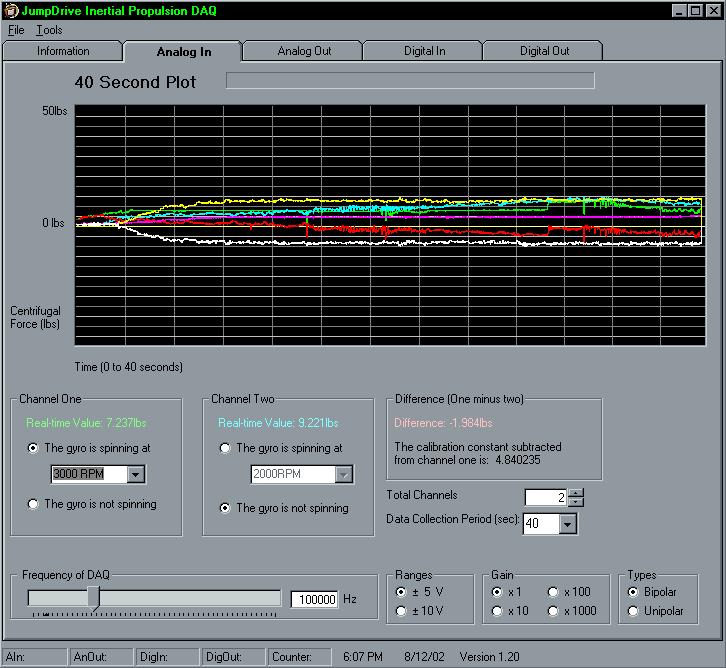
Gyro Variable, Channel One Gyro 3000RPM - G_1_0_07
Note: This channel contains the gyro which was balanced.
Raw Data Filename - "C0 - G_1_0_07.txt" (Contained in "Raw Data for Gyro Variable.zip")
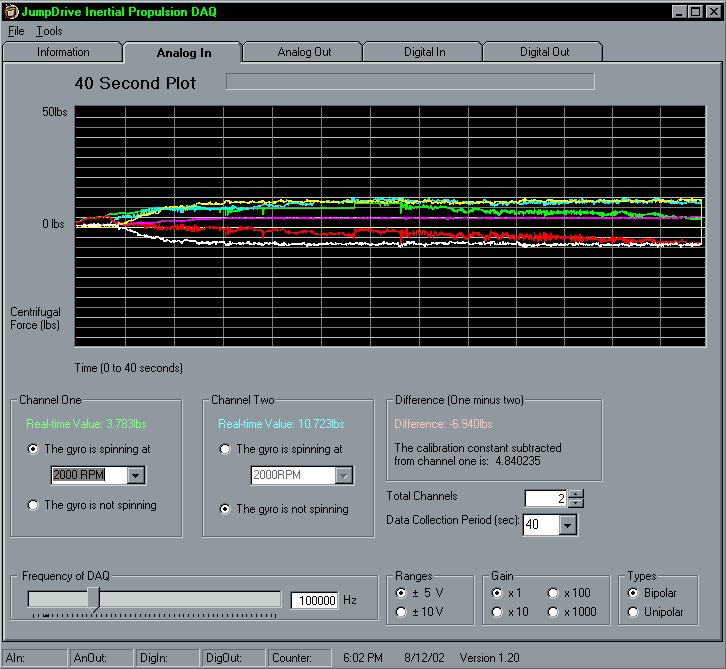
Gyro Variable, Channel One Gyro 2000RPM - G_1_0_08
Note: This channel contains the gyro which was balanced.
Raw Data: "C0 - G_1_0_08.txt" (Contained in "Raw Data for Gyro Variable.zip")
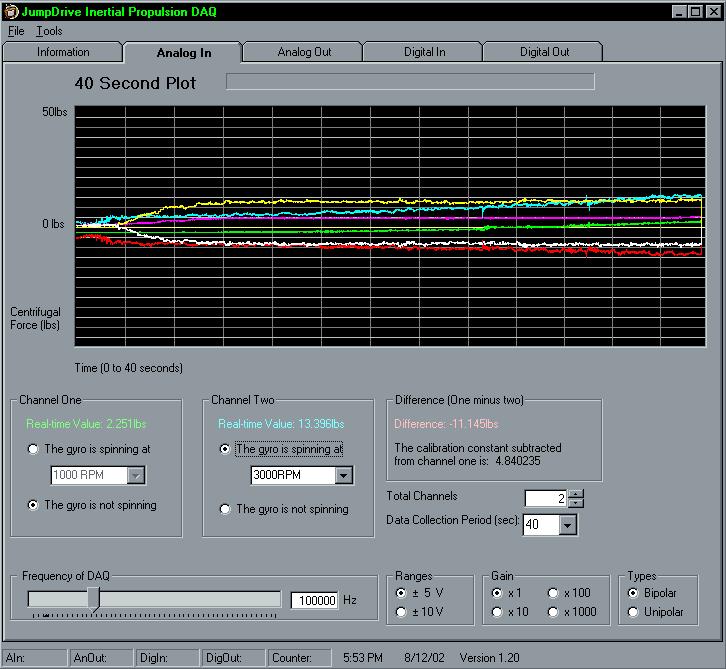
Gyro Variable, Channel Two Gyro 3000RPM - G_2_0_6
Raw Data: "C0 - G_2_0_06.txt" (Contained in "Raw Data for Gyro Variable.zip")
Gyro Variable, Channel Two Gyro 2000RPM - G_2_0_7
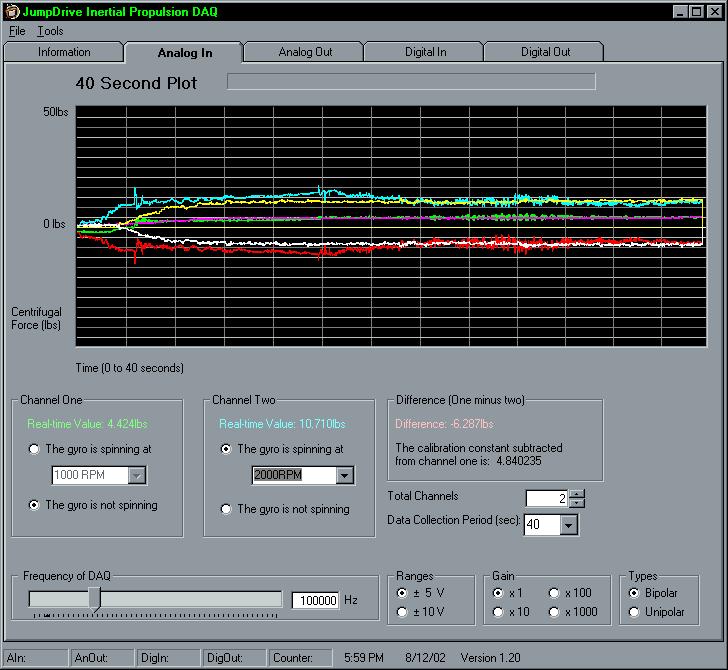
Raw Data: "C0 - G_2_0_07.txt" (Contained in "Raw Data for Gyro Variable.zip")
5. Analysis
The graphs (G_1_0_07 and G_2_0_6) clearly show that when either gyro is precessing, the distance in pounds between it and the non-spinning is about 10 to 12lbs. When the precessing gyro slows down, the difference between them starts to look like the baseline where the difference is only about 5 to 7 pounds.
However, Bill brought a up good point when he mentioned that:
> I would be inclined to apply varying weights on the arm while stationary, just to prove to myself that this had no effect on the cell's reading.
The above was done by applying an increasing pressure on the end of the axle which created a negative difference for both channels which attained a maximum of a 5lbs difference for both channels,. With about 12 lbs pressure on end of the axle, it seems the arm assembly is backing up and releasing the pressure on the load cell.
It is suspected that the leverage, as described, is what is creating the increase in the centrifugal force when either gyro precesses. The process works like this: If a pressure on the end of the axle decreases the force measured by the load cell then this means if the gyro was lifted off the support the load cell would measure more force then at rest. Precession lifts the gyro off it's rest, hence the increase in centrifugal force.
The easiest way to avoid this is to support the axle on the other side of the gyros, the results of which are documented in the modified 12" results.
Description | Setup | Initial Results | Next Results | 12" Gyro Results | Next 12" Results |
C1 Results | Next C1 | Final C1
JumpDrive Confidential, 2002 - All right reserved, no part of this document may be reproduced without the authors permission.